
I was lucky enough to attend Anime Expo this year and squeeze into the U.S. premiere of the movie adaptation for Tatsuki Fujimoto’s Look Back! What I witnessed was a passionate usage of the medium that channeled the original work’s themes and set the standard for future adaptations of the acclaimed mangaka’s works. AX staff shuttled the premiere into an incredibly small panel room of about 200 seats, resulting in hundreds of attendees being shooed away at the door. I’ve taken it upon myself to recount what I saw for those attendees, as well as all Look Back fans who eagerly await the film’s widespread release.
The following contains spoilers for both movie and manga versions of Look Back.
Look Back has some very intriguing production credits. The movie is directed by Kiyotaka Oshiyama, acclaimed director of Flip Flappers and key animator on numerous works, including Oscar-winner The Boy and the Heron, fan-favorite Devilman: Crybaby, and landmark classic Eromanga Sensei. The screenplay was co-written by Fujimoto and Oshiyama himself. The storyboards for Look Back were illustrated by… uh, Kiyotaka Oshiyama? Hmm, the animation director is somehow also Kiyotaka Oshiyama. Character design was done by, wow, Kiyotaka Oshiyama… And key animation was done in part by, you guessed it, Kiyotaka Oshiyama! Good Lord, it might be easier to list off which shoes the director didn’t help fill.
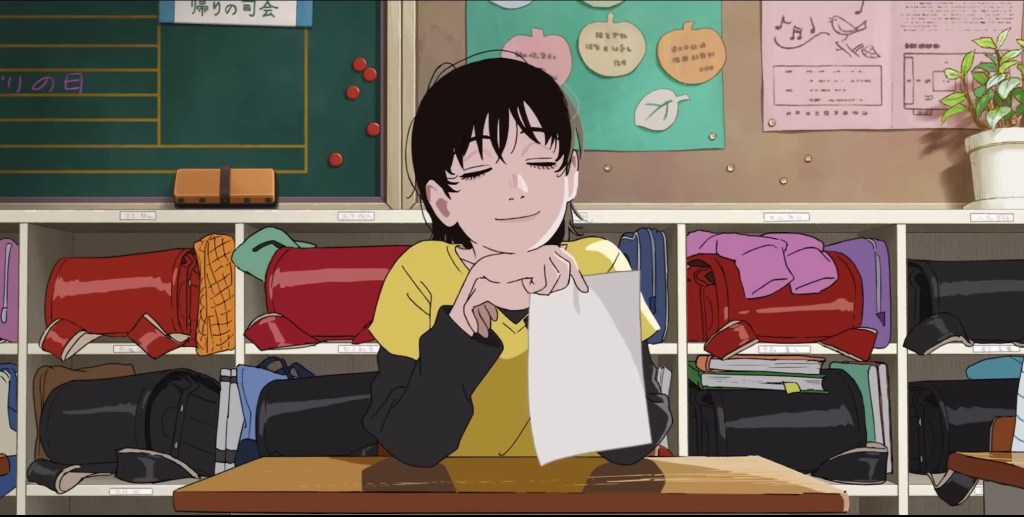
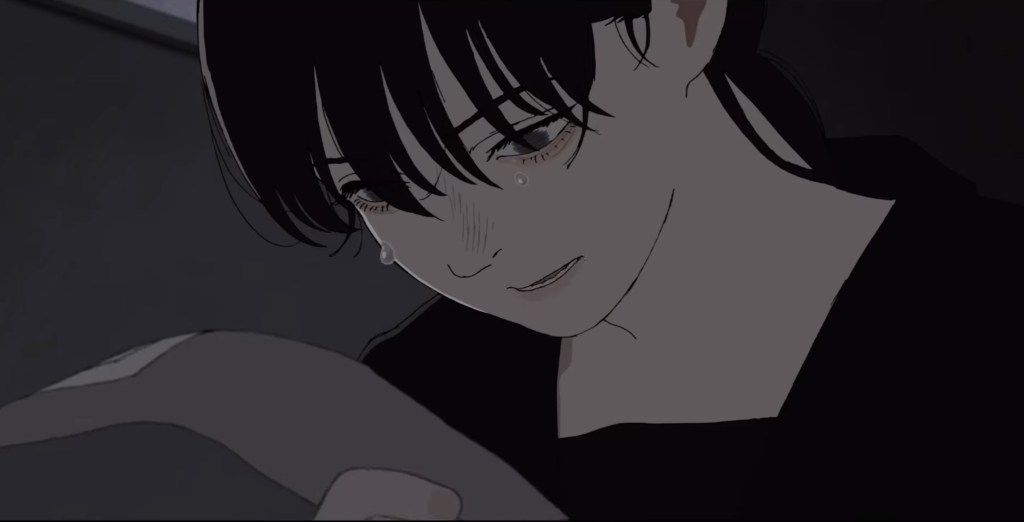
Oshiyama confirmed in a Q&A following the film’s premiere that his heavy involvement is how Look Back possesses such a melancholy look that replicates the original’s art style so closely. Oshiyama commented how the linework and colors in the film almost give off a “rustic” look in appearance, which was done intentionally. The film’s colors take on a warm and comforting aesthetic when the kids are busy creating one-shot manga from Fujino’s bedroom, and enter a darker and more desaturated look during Fujino’s adult years as a mangaka. Oshiyama and the CG team over at Studio Durian also know how to utilize 3D animation to create dynamic camera angles and zooms. Take for example, the POV of Kyomoto as she bursts out of her bedroom to find the diploma that Fujino has left on her doorstep. These moments don’t detract from the vivid linework, and instead, add a sense of surrealism to a movie that already looks like its frames have been transplanted from its source material.
There is some clever visual experimentation that shows the director didn’t simply adapt the manga panel-by-panel… Actually, wait. He DOES do this! Quite literally, in a scene where Kyomoto is working on her own 4-koma manga strip, her process is displayed in a series of animated manga panels. Then, a gust of wind blows through her bedroom window and carries the manga strip away from her desk. The camera shifts to a dynamically rotating POV that follows the strip as it sweeps underneath Kyomoto’s bedroom door. Fun additions like this can only be achieved in anime, and this is where Oshiyama’s influence is strongest. One of the challenges that the director cited in making the transition from paper to the big screen was how some of Look Back’s scenes didn’t “feel” like anime to him. In order to solve this, Oshiyama met with Fujimoto a couple times during the film’s production to make sure that specific details translated over properly.

When asked during the film’s Q&A about the merits and demerits of being so heavily involved in nearly every step of the process, Oshiyama said that there were certainly downsides. The biggest demerit for him was when staff members would approach him with questions that they could not work through alone. Essentially, his involvement in many of the film’s production processes created a bottleneck. Heck, Oshiyama confirmed during the panel that he drew most of the keyframes by himself! But Oshiyama also felt that his level of involvement is what gives Look Back its visual style, and it’s inherently his style which he wished to represent within the film.
What struck me as unique about this film as soon as it started was its use of audio, or rather the lack thereof. There are many scenes where no dialogue is spoken, no music is being played, and only a subtle sound effect would occur here or there. These sound effects are very crisp and elicit physical sensations, like Fujino’s anxious foot tapping as she’s cracking away at her serialization, Shark Kick. There’s also the soft taps and scrapes that can be heard coming from Fujino’s stylus as it glides across her drawing tablet. The quiet and reflective silence, lightly garnished by hand-picked sounds, further establishes the movie’s pacing. It’s almost as if time doesn’t even exist outside of these moments where these kids are passionately creating manga.
These silences are also adorned with dialogue, and as a fan who’s read Look Back countless times, it’s a real treat to hear Kyomoto speak. In the manga, her voice is characterized by shaky speech bubbles and sentence run-offs… But in the movie, you can hear the uncertainty in her voice, and how her diaphragm shakes. Mizuki Yoshida truly knocks it out of the park with her mumbly rendition of Kyomoto. Hilariously enough, Fujino sounds exactly like I imagined her to be — headstrong, annoyed and confident. The voice that Yumi Kawai lends to Fujino isn’t high pitched, but rather possesses a deep and somewhat sarcastic tone to imply that whoever she’s speaking to is wasting time which would be better spent drawing.

When it comes to the soundtrack, Oshiyama has taken an approach of less-is-more with light piano keys and some orchestral backing when appropriate. During the convenience store scene, there are slow piano keys that wait to enter until after the two kids see their one-shot get published in that week’s Shonen Jump. Like the long, stretched out moments of silence, the music takes its time when it wants to. Then, when Fujino is shown living her post-high school years as a professional mangaka in the heart of Tokyo, the music crescendos into a battle song of major notes jaunting along drums and strings. Lots of slice-of-life drama films nowadays use piano and orchestras to fill the space, but Look Back feels a bit more intentional with its choice of music and when it’s played.
One of my favorite scenes in the book is when Fujino and Kyomoto receive their first paychecks from Shonen Jump, and Fujino presents Kyomoto with 100,000 yen in cold, hard cash. The long pause of silence before Kyomoto mumbles, “you could buy a house with that” was followed by an uproar of laughter from the audience. The silence between the hard clatter of Fujino’s phone as it hits the floor and the reveal of Kyomoto’s funeral photo in her family’s home was finally broken by deep breaths from several audience members. One big fanfare moment that I’m sure will entice Fujimoto fans came from the montage showing both kids using their hard-earned money to “stimulate the economy,” as Fujino puts it. The kids hit up a crepe place, peruse a book store, eat at a McDonald’s… but most importantly, they go see a movie. And which movie did they see exactly? Well, in the book, we only see the kids’ faces as they sit in a mostly-empty matinee. But here, the movie screen is shown to be playing a scene from Fujimoto’s other well-known one-shot, Goodbye Eri. The emphatic cheers that filled the panel room at AX were probably heard by attendees on the first floor.

We’re currently living in a world full of gorgeous anime films about adolescence in the wake of Your Name, resulting in films like Fireworks, I Want to Eat Your Pancreas, and Penguin Highway. I wholeheartedly believe that Look Back has the potential to stand out amongst the best of them as a story about creative adolescence. Fujimoto’s original book does not pull punches about how difficult the world of making manga is, yet it highlights the little moments about the lifestyle that make every challenge worthwhile. Oshiyama’s vision and dedication immortalize that message into beautiful linework, melancholy colors and a wise sense of sound.
When asked about the future and what his next work looked like, Oshiyama said that he doesn’t really like to plan ahead. After being involved in nearly every step of the production, he’s ready to take a break and focus on the here and now. However, he also said that he knows himself too well, and that he can’t stay away from drawing for long. He closed off the panel with the usual elephant-in-the-room question that all successful creatives are asked: “Do you have any advice for individuals in creative fields today?” I knew what he was going to say. It would be an answer reminiscent of when Fujino first Googles “how to become a better artist” in the beginning of the manga. He simply said, “just write, just draw.”
I feel very privileged to have seen this film, and I can’t wait to see what else Oshiyama will do in the future! I can’t believe I’m saying this, but I actually prefer the movie version over the source material. I’ve always been a bigger fan of moving images than stills anyways, but this adaptation really nails all the finer details of the book while also adding some new ones. Manga fans nationwide will get to decide which version they prefer thanks to GKIDS, who will be screening the film in theaters everywhere on October 4th! If you’d like to read a deep dive analysis on Look Back’s story itself, check out my original review of the manga here.

 Advent Seven
Leave a comment