
We all have dreams growing up. Some of us want to be firefighters, athletes or even superheroes… Look Back asks the question, “what if you didn’t give up on those dreams?”
You may have heard of Look Back’s author, Tatsuki Fujimoto, for his hyper-violent serialized manga, Chainsaw Man. Or maybe you’ve read his breakout series, Fire Punch. Either way, Fujimoto’s stories typically have a sense of derangement about them, with some kind of supernatural twist. Look Back was published in Shonen Jump+ in July 2021 during Fujimoto’s hiatus on Chainsaw Man, and it may be his most grounded work yet.
The following contains spoilers for the entirety of Look Back.

The story revolves around Fujino, a talented fourth-grade artist who draws 4-panel manga strips for her school’s weekly newsletter. Fujino’s classmates praise her artwork and ask for autographs, which she takes for granted. She will even brag about how little time she actually spends on drawing, sometimes only taking five minutes to make her weekly comics before they’re due. Drawing manga is not a passion for Fujino – it’s an innate talent that earns her the spotlight in her class. One day, however, another kid from the class next door submits their own manga strip to the newsletter, and the quality of Fujino’s competition is staggering.
As one of Fujino’s classmates proclaims, this new kid’s art quality is pro-level. Suddenly, Fujino’s title as the school’s most talented fourth-grade artist is hanging in the balance, and that is something she cannot allow. Fujino rushes to the bookstore to buy stacks of tutorial books and proceeds to draw day and night for two whole years. I commend Fujimoto on how he portrays Fujino’s growth as an artist. It’s not overnight, and it’s not met with praise. Fujino’s family and friends warn that she may become a social outcast at this rate, and Kyomoto’s art quality continues to improve as well, thereby maintaining the miles of skill between the two. One day, Fujino’s class receives another weekly newsletter, and after having lost another fight with her genius rival, Fujino decides to call it quits. She did her best, and now it’s time for her to return to normal life. Back to ice cream after school, karate lessons with her sister, weekly family movie nights.
This is the pivotal moment where Fujimoto presents two different routes that Fujino’s life could follow. In the first, she has a chance encounter with Kyomoto at the end of sixth grade that results in the two becoming friends. They eventually join forces and become a national manga sensation that reaches the top brass of Shonen Jump itself. In the second, Fujino goes on to practice karate with her sister, taking advantage of her athletic abilities and eventually pursuing karate in college. It’s here that fate brings her face-to-face with Kyomoto, but it’s in a life-or-death situation where Fujino inadvertently saves Kyomoto from a serial killer. It’s still a Fujimoto story, after all. The first route may sound more ideal for finding success, but truthfully both paths have pros and cons – let’s break down each of the key factors of Fujino’s manga career.

Time
In the first route, Fujino only gives up her dream of making manga for a few months at best. Upon meeting Kyomoto, she continues to make manga throughout middle and high school, essentially missing out on most of life’s nuances but investing over eight years into becoming a famous manga author. In the book Outliers: The Story of Success by Malcolm Gladwell, it is said that mastering a skill requires roughly 10,000 hours or ten years in order to become a world-class expert in any field. As any aspiring creative knows, it’s much easier to find said time as a child than it is as a working adult. And Fujino still gets to occasionally spend her published manga’s profits on a day of fun in Tokyo with Kyomoto, her best friend and partner-in-crime. However, this route ends with Fujino and Kyomoto parting ways at the end of high school, and Fujino goes on to spend all her time making manga instead of memories. Due to a sudden tragedy at Kyomoto’s art school, Fujino loses the opportunity of ever spending time with her best friend again. Suddenly, all the time Fujino spent making manga seems like a waste.
In the second route, Fujino steps away from manga for at least six years. However, Fujino expresses to Kyomoto that she’s recently gotten back into drawing during college, and plans to become a published author someday. While it may take her another decade to reach the same pinnacle her previous iteration did, it will not be at the cost of all the time she has spent living between elementary and college. And if drawing is something that Fujino truly wants to do, then she can rearrange her free time to allow for a couple hours of drawing per day. Additionally, in this timeline, Fujino gets to reconvene with Kyomoto and make up for lost time. I’m reminded of a scene from Paulo Coelho’s The Alchemist, where the main character is assigned the task of carrying a bucket of oil throughout an entire museum without spilling a single drop. The main character succeeds, but fails to take in the scenery around him. Life is not just about pursuing a goal – it is also about living in the present moment.

Skill
Fujino starts out as a fairly talented artist for a fourth-grade level. Exaggerated anime eyes, stick figures and speed lines create a sense of playfulness in every frame of her comics. By the end of sixth grade, the anatomy of Fujino’s characters is more balanced and she has basic perspectives down, but her depth and realism are still about as good as a background panel in Bleach. Gladwell’s 10,000 hour rule doesn’t just apply to time spent – it applies to time spent learning a skill properly. In the first route, Fujino’s skills vastly improve by the end of middle school thanks to continuously practicing and working with Kyomoto. She polishes her skills to pro-level before she graduates high school, and her book idea “Shark Kick” gets serialized almost immediately. Again, however, Kyomoto isn’t part of the latter phase of Fujino’s career, and Fujino doesn’t see the need to attend art school when her skills are already sufficient. Without her primary assistant to bounce ideas off of, Fujino’s skill increase comes to a crawl, and her days in serialization are more about the volume of work rather than the improvement of it.
In the second route, Fujino’s art is admittedly still at a sixth-grade level during her college years. Additionally, drawing is like a muscle – it becomes weaker over time if not exercised regularly. Fujino can dedicate time throughout her life to draw again, but if she doesn’t hold herself to a strict discipline then she may never reach the mountain peak that her previous iteration did. Regardless, Fujino still expresses the desire to draw after meeting Kyomoto, and if the two end up working together in adulthood, then it’s possible they’ll still get a few one-shots published. Maybe it won’t be in Shonen Jump, but there’s plenty of other manga publications. A skill is only built upon talent and desire at the end of the day, so as long as Fujino has both of those then she has plenty of opportunities to improve.
Fulfillment
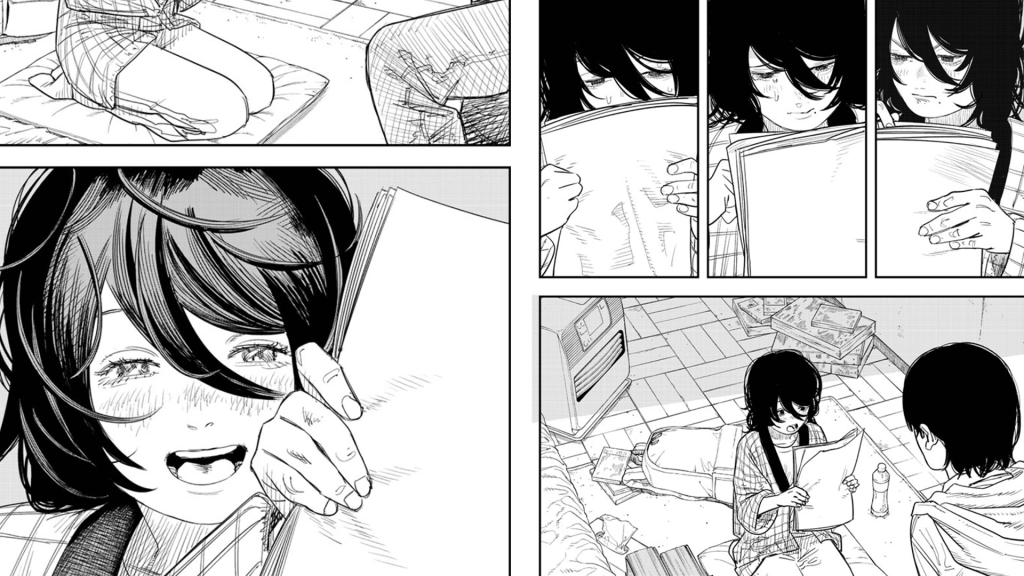
There’s a scene towards the end of Look Back that takes place in the first timeline from Fujino’s bedroom, where she confesses to Kyomoto that she doesn’t even like drawing. “It’s not fun,” she says. “You can draw aaall day long and still be nowhere near finished.” Fujino draws because it’s an easy way for her to gain the spotlight in her class, her town, and her favorite publication. After initially giving up on manga and then getting back into it, Fujino continues to grind from her desk. Even as a published manga author, Fujino never shows any signs of enjoying the process. But it’s clear that Fujino draws so she can see Kyomoto’s excited reactions to each and every page. Kyomoto is both Fujino’s best friend and her biggest fan, and having even one true fan is better than a class full of apathetic readers. So it’s all the more tragic when Fujino loses her one and only reason to draw.
In the second route, Fujino reveals to Kyomoto that after spending more than six years away from drawing, she’s recently gotten back into it again on a whim. And in typical Fujino fashion, she confidently invites Kyomoto to work with her someday, proving that she’s still aiming for the spotlight. If you have the creative drive and the itch, then it’s impossible to stay away from creation for long. And even if Fujino never becomes a successful author in this route, at least she can talk about drawing with a smile on her face.
There’s always more than one path towards a dream. Just because you gave up on something in childhood doesn’t mean you can’t return to it in adulthood. And just because you committed your younger years to a goal that stays out of reach doesn’t mean that it won’t arrive on your doorstep someday. Both paths in Fujino’s story have pros and cons; pursuing a dream comes with a cost. That cost could be time spent with family and friends, or it could be the passion you once held for a hobby that’s now become a job. There’s also no guarantee that the exponential time and effort you invest in a dream will actually pay off. Regardless, the key to finding success is to keep trying. If life gets in the way, take a step back and take a breather, but come back to it again. If you don’t give up, then anything’s possible.


 Advent Seven
Leave a comment